Most of what’s been written about the recast Union Customs Code focuses on dates and duty rates — when the €3 charge started, when the political agreement landed, when Parliament would finally vote. That vote is now behind us: the European Parliament adopted the text on 16 September 2026, and Regulation (EU) 2026/2108 — establishing the new Union Customs Code and the EU Customs Authority, and repealing Regulation (EU) No 952/2013 — was published in the Official Journal on Saturday 19 September 2026, entering into force the following day. This is no longer a proposal moving through the legislative process; it is law, with implementation now beginning in phases.
Less has been said about the piece that actually carries the reform: the EU Customs Data Hub, the system meant to replace 27 separate national customs IT platforms with one.
The European Commission calls it the “engine” of the new customs architecture. That’s not marketing language — it describes how the Hub is built to work.
What the Hub replaces
Today, a business moving goods into the EU deals with whichever national customs system happens to sit at the border of entry — French, German, Dutch, Polish, each with its own interface, its own quirks, its own filing rules. The EU Customs Data Hub is designed to remove that fragmentation. Over time, it will replace the existing IT infrastructure in every Member State, and the Commission puts the savings at up to €2 billion a year across national administrations once that migration is complete.
Oversight sits with a new EU Customs Authority, created alongside the Hub and expected to take up its role from 2027. The Authority doesn’t just watch the data flow — it’s meant to coordinate risk assessment across all 27 Member States, something no single national customs administration can currently do on its own.
How data actually moves through it
The mechanics are the real departure from how customs works today. Instead of filing a declaration for each shipment, a business logs its product and supply chain information into the Data Hub once, through a single EU-level portal, and that data can then cover multiple consignments. The Hub compiles what’s submitted and, using machine learning and artificial intelligence alongside human review, builds what the Commission describes as a 360-degree view of a company’s supply chain — not just a snapshot of one shipment, but a running picture of how goods move, where they originate, and how consistent that pattern is over time.
That data is shared with national customs authorities and the EU Customs Authority in something closer to real time, replacing the current model where risk information mostly stays inside whichever Member State happens to see the shipment.
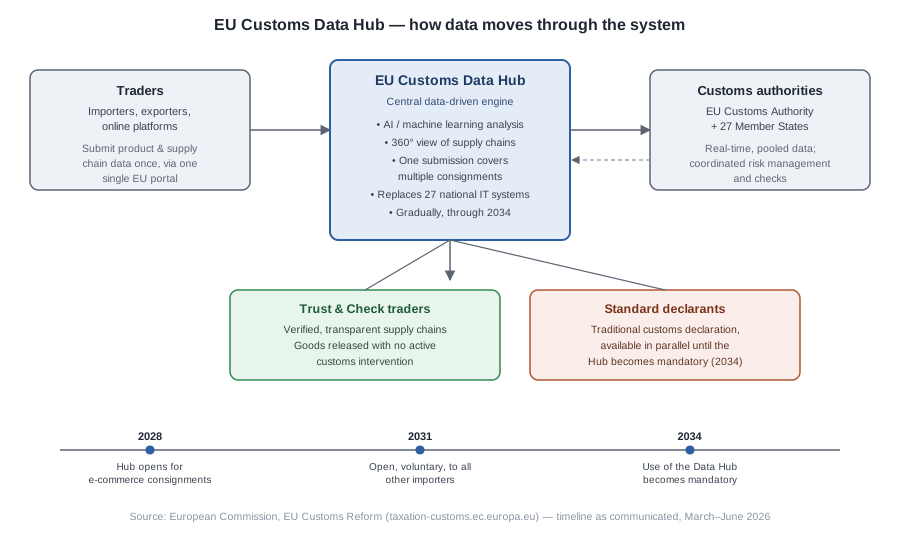
CB Consulting & Management — based on European Commission, EU Customs Reform, status as of 23/09/2026
Two ways through the system
Not every trader ends up in the same place once their data is in the Hub. Businesses with genuinely transparent, well-documented supply chains can apply for “Trust and Check” status — an extension of the existing Authorised Economic Operator programme, but with a different logic. Rather than periodic audits, Trust & Check relies on the continuous, data-driven picture the Hub already has. In practice, that means the most trusted traders can have their goods released into free circulation without any active customs intervention at all.
Everyone else continues through something closer to today’s process: a standard declaration, reviewed against the same pooled data and AI-driven risk analysis, but without the fast lane. The two tracks are meant to coexist — the traditional declaration route stays available even after the Data Hub goes live, so the shift isn’t a single cutover date but a long transition.
What changes first: e-commerce, and who counts as the importer
The Hub’s first real test comes through e-commerce, and it arrives alongside a shift in who’s legally on the hook. The final text is explicit on this point, and broader than a lot of the commentary around it suggested: sellers and platforms facilitating distance sales of goods shipped directly from a non-EU country to an EU consumer are treated as importers. That’s not limited to marketplaces acting as deemed supplier for VAT purposes — a merchant selling directly through its own website or a platform like Shopify, with no marketplace intermediary involved at all, falls under the same customs importer obligation. The deemed-supplier concept under the VAT rules and the customs importer role created by this reform are two different mechanisms, and the second one doesn’t depend on selling through a marketplace to apply. In either case, the responsible party must be established in the EU or represented by an EU-based entity holding Authorised Economic Operator or Trust & Check status.
That importer obligation covers ensuring customs duties and VAT are paid at the point of purchase, rather than leaving that burden with the consumer or the carrier delivering the parcel. Alongside it, the reform introduces a separate EU-wide handling fee on direct-to-consumer consignments from non-EU countries, distinct from the transitional €3 duty — the Commission will set the amount and review it every two years, and Member States must start collecting it no later than 1 November 2026. Paired with the abolition of the €150 duty-exemption threshold and the simplified four-category duty structure for low-value goods, the Commission expects the e-commerce regime as a whole to generate around €1 billion a year in additional customs revenue.
The rollout, in three dates
The Commission’s own timeline sets out three milestones for the Data Hub itself. It opens first for e-commerce consignments in 2028. From 2031, it becomes available, on a voluntary basis, to all other importers — a business can choose to move onto it ahead of the deadline if it’s ready. Use of the Hub becomes mandatory for everyone by 2034, at which point the transitional dual-track system ends and the national customs IT it was built to replace is retired for good.
The Data Hub timeline is still several years out, but the legal foundation underneath it no longer is. With Regulation (EU) 2026/2108 now in force, the practical implication for any business trading into the EU — whether it sells through a marketplace, its own site, or both — is that the data discipline the Hub expects, and the importer obligations that already apply, are worth acting on now rather than waiting for the 2028 and 2034 deadlines to force the issue.
Sources: