From 1 November 2026, a typical low-value parcel from China can carry more in EU levies than half its retail price. On top of the €3 flat customs duty in force since 1 July, a €2 Union handling fee now applies per item, and product identifiers become mandatory on the customs declaration.
On 26 October 2026, the French customs administration (DGDDI) published an administrative decision consolidating the three measures for operators. It is a useful, practical text. It also contains one statement on customs warehouses that the European Commission’s own guidance contradicts.
This article sets out the rules, runs one worked example through three scenarios, and tests the only two legal ways to reduce the bill: holding stock in the EU and claiming preferential origin.
The rules on one page
Three measures now stack on every distance sale of goods imported from a third country to an EU consumer.
| Measure | Amount | Scope | Key feature |
|---|---|---|---|
| Temporary flat duty | €3 per item | Consignments up to €150, 1 July 2026 to 1 July 2028 | Replaces the former €150 relief, even for goods at 0% in the common customs tariff |
| Union handling fee (UHF) | €2 per item | All distance sales, no value threshold, from 1 November 2026 | Non-refundable, due on acceptance of the declaration even if the goods are never released |
| Product identifiers (PID) | 2 to 3 codes per product | Consignments up to €150, mandatory from 1 November 2026 | Merchant and manufacturer identifiers always; standardised identifier (e.g. EAN) where it exists |
Three definitions drive the bill:
- Item. Goods in a consignment sharing the same tariff classification, description and, where the dataset requires it, origin (Article 5(78) of the new Union Customs Code). In an H1 declaration this means TARIC 10 digits split by origin; in an H7, HS 6 digits with no origin. Grouping items under the highest duty rate is not allowed.
- Distance sale. Borrowed from the VAT Directive (Article 14(4)(2)): the goods must be in a third country when the sale is made, and shipped to the consumer by or on behalf of the seller.
- Declarant. Until 30 June 2028, a cascade applies (Article 85(2) of the new code): the IOSS holder or its indirect representative; failing that, the user of the special arrangements or its indirect representative; failing that, the importer’s indirect representative. The consumer is not the debtor, except in a residual case some Member States allow.
The practical consequence of the cascade is often missed. A carrier acting as indirect representative becomes jointly liable for the €3 and the €2 on every line it declares. For the detail of how the fee is counted, see the article on the Commission’s guidance of 5 October.
Worked example: a €41 parcel, classic distance sale
A French consumer orders four products from a Chinese seller using IOSS. The parcel is declared in H7.
| Product | Classification (indicative) | Price | Normal duty rate |
|---|---|---|---|
| 2 cotton T-shirts | 6109 10 00 | 2 × €8 | 12% |
| 1 phone case (plastic) | 3926 90 97 | €5 | 6.5% |
| 1 pair of earphones | 8518 30 00 | €20 | 0% |
The levies on this €41 parcel come to €23.20, or 57% of the price:
| Levy | Calculation | Amount |
|---|---|---|
| Flat duty | 3 HS-6 lines × €3 | €9.00 |
| Handling fee | 3 lines × €2 | €6.00 |
| VAT via IOSS | 20% × €41 (duty and fee excluded if not charged to the buyer) | €8.20 |
| Total | €23.20 |
Three points stand out:
- The earphones pay €5 at the border although their normal duty rate is 0%. The flat duty replaces a relief, not the tariff.
- The declaration type changes the bill. In H1, the same parcel could split into more lines (TARIC 10 digits, one line per origin), each adding €5. H7 aggregates at HS 6 digits. See why the €3 is counted per declaration line.
- A wider basket costs more, regardless of value. Every new HS-6 position adds €5, which penalises multi-category marketplaces more than single-category brands.
Returns no longer help either. Invalidation of the declaration for returned goods is no longer available for these parcels. The €3 can still be reclaimed through the ordinary repayment procedure, but the €2 fee never can.
Exit 1: hold the stock in the EU, but pick the right warehouse
The test is simple: where are the goods when the consumer buys them? If they are already in the EU, the sale is not a distance sale of imported goods, and neither the €3 nor the €2 applies. There are two ways to get there, and they do not have the same life expectancy.
Customs warehouse: valid today, on borrowed time. The French decision states that a sale made while goods are stored in a customs warehouse is not a distance sale. That is a fair reading of the current text. But the Commission’s guidance of 5 October 2026 announces an amendment to Article 201(e) of the UCC Delegated Act. Once it applies, goods sold while stored in a customs warehouse will pay the €3 and the fee, because they have no Union status. They will also generally lose access to preferential rates.
Logistics warehouse: the durable route. Goods are cleared as a B2B import, obtain Union status, and are only then sold to consumers. They pay normal duty on their B2B value. The amendment announced by the Commission does not target this model.
Both routes face the same anti-abuse clause (Article 243(5) of the UCC Implementing Act). If goods were already sold to consumers before entering the EU, customs will look through the bulk import and treat each order as a distance sale. The timing of the sale must be provable: order timestamps, inbound dates, stock records.
For our €41 basket, EU stock brings the levies down to about €10.45:
| Levy | Calculation | Amount |
|---|---|---|
| Normal duty | €16 × 12% + €5 × 6.5% + €20 × 0% | €2.25 |
| Flat duty and handling fee | Not a distance sale | €0 |
| VAT on the domestic sale | 20% × €41 | €8.20 |
| Total | €10.45 |
This calculation leaves out what EU stock costs to run: warehouse fees, guarantees, the seller’s VAT registration or OSS, and the inventory risk. It also takes the consumer price as customs value, which is conservative; in a logistics warehouse the B2B value is lower. In an intra-group flow, that value is a transfer pricing question.
After 1 July 2028, a new customs warehouse for distance sales (Article 145 of the new code) opens to Trust and Check traders, with a reduced handling fee. It cannot be used before that date.
Exit 2: preferential origin, wider than the UK but narrower than it looks
Goods that qualify for a preferential rate under an EU trade agreement escape the €3 duty. They do not escape the €2 fee, which applies to every distance sale whatever the origin.
The route is not limited to British goods. It covers any product that genuinely originates in a partner country: Korean cosmetics, Vietnamese apparel, Swiss or Japanese products, Canadian goods under CETA, and Turkish industrial goods under the customs union. What limits it is not the list of agreements but four conditions, all cumulative:
- Real origin. A Chinese product shipped from a UK warehouse is not of UK origin. This is the most common mistake.
- No IOSS. The €3 applies to every IOSS import by law. Preference can only be claimed under the special arrangements or standard import VAT.
- An H1 declaration with a preference code (2, 3 or 4) and valid proof of origin.
- Line by line. Each item is assessed separately. In a mixed parcel, non-originating lines stay at €3.
The gain is smaller than expected, because import VAT is then paid at the border on a base that includes the fee. For a UK seller shipping our €41 basket:
| Scenario | Duty | Handling fee | Import VAT | Total |
|---|---|---|---|---|
| All three products of UK origin | €0 | €6.00 | 20% × €47 = €9.40 | €15.40 |
| T-shirts of UK origin, case and earphones made in China | €6.00 | €6.00 | 20% × €53 = €10.60 | €22.60 |
With one non-originating product in the parcel, the saving almost disappears: €22.60 against €23.20 in the classic scenario. Preferential origin works for brands whose whole catalogue is made in a partner country, not for resellers.
The three scenarios side by side
On the same €41 basket, EU stock halves the levies; preferential origin only helps when the whole parcel qualifies.
| Scenario | Duty | Fee | VAT | Total | Durability |
|---|---|---|---|---|---|
| Classic distance sale (IOSS, H7) | €9.00 | €6.00 | €8.20 | €23.20 | Until 1 July 2028 |
| Customs warehouse, sale during storage | €2.25 | €0 | €8.20 | €10.45 | Transitional |
| Logistics warehouse, cleared B2B | ≤ €2.25 | €0 | €8.20 | ≤ €10.45 | Durable, subject to anti-abuse |
| Preferential origin, whole parcel | €0 | €6.00 | €9.40 | €15.40 | Durable |
| Preferential origin, mixed parcel | €6.00 | €6.00 | €10.60 | €22.60 | Durable |
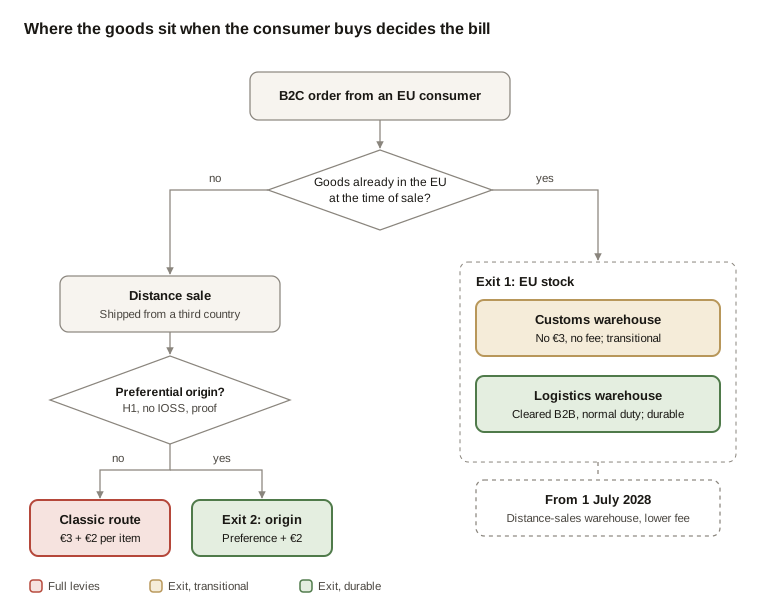
One question decides the route: where the goods are when the consumer pays. Everything else follows from it.
What sellers, platforms and carriers should do now
- Price per tariff line, not per parcel. The €5 per HS-6 position makes basket composition a margin lever. Single-category bundles cost far less than mixed baskets.
- Treat the customs warehouse as a bridge, not a model. Build on a logistics warehouse with cleared stock, and document the timing of every sale.
- Claim origin only where it is real and complete. Map the origin of each SKU before leaving IOSS; one non-originating product cancels most of the benefit.
- Carriers: price the liability. As indirect representatives, you are jointly liable for the €3 and the non-refundable €2 on every line, and your comprehensive guarantee must cover both.
- Fix the product data before 1 November. Merchant and manufacturer identifiers must reach the declarant for every product, up to 99 per line.
Two caveats. The tariff rates above are indicative and should be checked in TARIC; the phone case could also fall under heading 4202. The date at which the amended Article 201(e) of the UCC Delegated Act will apply is not yet known.
CB Consulting & Management is an independent operational tax and customs consulting firm, with 22 years of hands-on experience in EU VAT and customs. If these questions are open in your business, book a call and get one focal point for both.
This article is general information based on publicly available texts and the Commission’s non-binding guidance. It is not legal or tax advice for your specific situation.
Sources: European Commission, DG TAXUD, “The temporary EUR 3 customs duty and the Union handling fee – Guidance for Member States and Trade”, version of 5 October 2026 (explanatory, not legally binding); Regulation (EU) 2026/2108 (new Union Customs Code), OJ of 19 September 2026, Articles 5, 20, 85, 145 and 287; Council Regulation (EU) 2026/382 of 11 February 2026; Commission Delegated Regulation (EU) 2026/2152 of 21 September 2026 setting the amount of the Union handling fee; Commission Delegated Regulation (EU) 2026/1022 of 30 April 2026 (product identifiers), OJ of 1 July 2026, corrected on 3 July 2026; Commission Implementing Regulation (EU) 2015/2447 (UCC-IA), Articles 222 and 243(5); Council Directive 2006/112/EC (VAT Directive), Article 14(4)(2); DGDDI, administrative decision of 26 October 2026 on measures applicable to distance sales (operators’ version).